

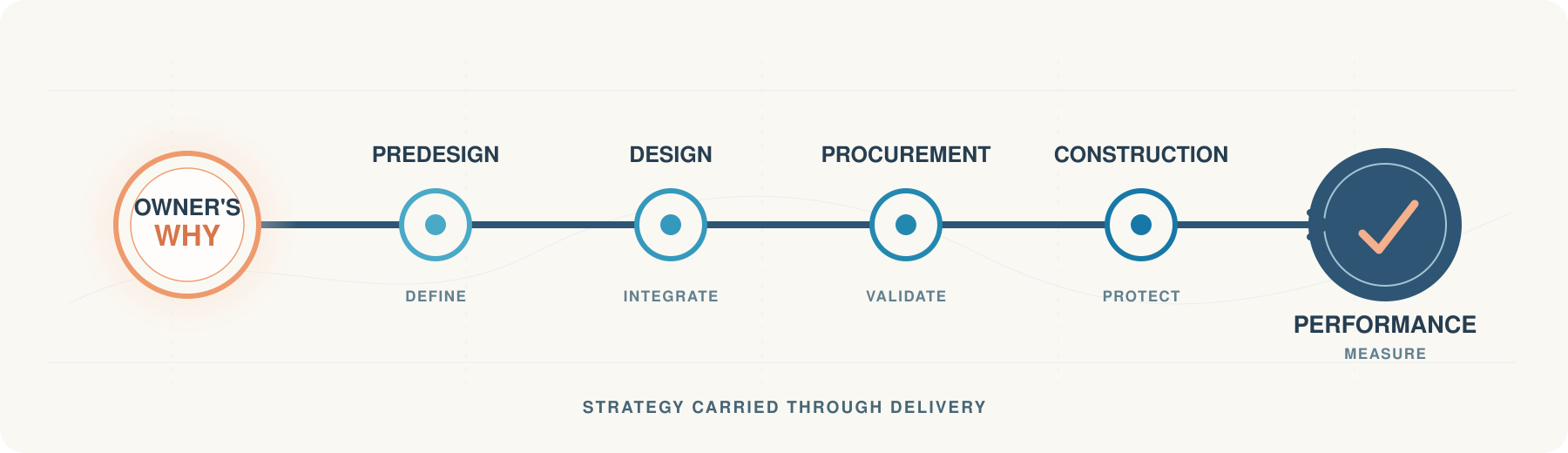
Define the Requirements. Implement the Strategy. Protect the Value.

Define → Quantify → Prioritize → Integrate → Protect → Measure
Services by project phase
Predesign Strategy: Define the outcomes
Design Guidance: Translate strategy into requirements the design team can implement
Procurement and Cost Evaluation: Create an accurate basis for decision-making
Construction and Implementation: Protect the strategy. Value engineering should improve how the strategy is delivered, not quietly eliminate it.
Activation and Performance: Confirm the strategy delivers
Specialized Expertise
Acoustics and Speech Privacy: Pragmatic construction-based VE solutions
Manufactured and Adaptable Construction: Vehicles for project success

Quick Links Predesign | Design | Procurement | Construction | Performance | Acoustics | Adaptable Construction



Predesign Strategy: Define the Outcomes
Establish the owner’s mandates and measures of project success
Define clinical, operational, financial, and adaptability objectives
Quantify downtime, disruption, revenue exposure, and lifecycle costs
Identify risks and opportunities
Prioritize spaces and applications by change frequency, operational consequence, payback, and mission value
Develop the preliminary business case
Establish architect and contractor selection criteria


Design Guidance: Translate Strategy into Implementation Requirements
Convert owner objectives into measurable performance criteria
Establish Owner’s Project Design Requirements
Support development of the Basis of Design
Align programming & design decisions with the strategy
Evaluate manufactured, prefabricated, and conventional approaches
Review adaptability, constructability, acoustics, MEP integration, and lifecycle performance
Establish project criteria for architects, engineers, contractors, users, facilities, and key trades
Review drawings and specifications for alignment


Procurement & Cost Evaluation: Create an Accurate Decision-making Basis
Develop bid and performance requirements
Define complete trade scopes Identify transferred, reduced, and eliminated work
Reconcile conventional and manufactured estimates
Evaluate schedule, general conditions, operational impact, and lifecycle cost
Prepare complete-scope comparisons and cost-benefit analyses
Document the decision and its underlying assumptions
Carry requirements into bid packages and GMP development


Construction and Implementation: Protect the strategy. Value engineering should improve how the strategy is delivered, not quietly eliminate it.
Maintain alignment with the Owner’s project Requirements and Basis of Design
Participate in design-assist and coordination
Review submittals, shop drawings, mock-ups, and proposed substitutions
Evaluate RFIs, field conditions, and changes against project objectives
Participate in value engineering
Prevent isolated cost reductions from compromising larger project outcomes
Verify performance and implementation
Coordinate owner, design team, contractor, trades, and system providers


Activation and Performance: Confirm the strategy delivers
Assist facilities and users to operate, maintain, and modify the completed environment
Establish processes for future changes and upgrades
Facilitate documentation of system capabilities and responsibilities
Track downtime, modification costs, disruption, and operational performance
Compare actual results with the original success measures
Document lessons learned for future capital projects


Specialized Expertise: Healthcare Acoustics and Speech Privacy
Set Speech Privacy goals by area
Develop VE’d acoustic construction assemblies
Estimate SPP (Speech Privacy Potential)
Acoustics affects healthcare design, construction cost, adaptability, and the privacy experienced by patients and caregivers. Yet it is too often treated as a technical exercise rather than an integrated construction objective.
Acousticians provide essential analysis, calculations, and code-compliance guidance. I complement that expertise by translating acoustic goals into pragmatic, constructible, and proven value-engineered solutions that can be incorporated into early designs through the construction documents.
This construction-informed approach can improve speech privacy, reduce unnecessary construction costs, preserve adaptability, and prevent value-engineering decisions from compromising performance.
Acoustic guidance can be provided at any project phase, from establishing performance goals through design review, value engineering, construction detailing, and field-performance assessment.
Iannone Innovative Solutions provides construction acoustic advisory and educational services. Mike Iannone is not an acoustician or a licensed professional engineer. IIS does not provide acoustical engineering services, conduct on-site acoustic measurements or testing, perform advanced acoustic calculations or predictive modeling, prepare engineered acoustic designs, or certify compliance with codes, standards, or project performance requirements. For a more detailed overview of these services and limitations, view the Construction Acoustic Advisory white paper on the “Insights” tab of this website.


Manufactured & Adaptable Healthcare Construction: Vehicles for Project Success
Determine where manufactured construction can best support project objectives
Prioritize applications based on change frequency, operational impact, mission value, and ROI
Evaluate systems for clinical performance, adaptability, durability, and constructability
Establish performance and integration requirements
Compare manufactured and conventional solutions on complete scope (not wall price alone)
Identify trade offsets, schedule benefits, and operational savings
Coordinate architectural, structural, MEP, equipment, technology, and acoustic requirements
Develop the business case for owner and executive decision-making
Advance integration of the selected approach into design documents, estimates, bid packages, and construction
Protect the success goals through procurement, value engineering, and implementation